
2026
FALL 2026 – Retooling: Art, Ecology, and Climate Adaptation
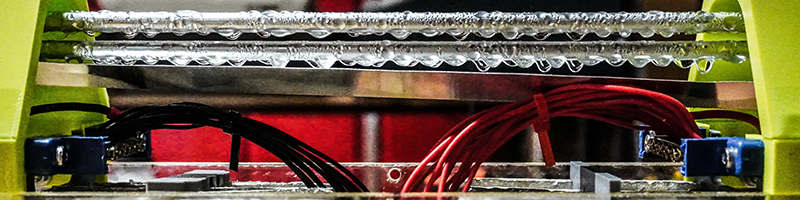
Please join us at the opening of Retooling: Art, Ecology, and Climate Adaptation at MESH_ARTS Center in Brooklyn, during Climate Week NYC! The exhibition asks what happens when artwork shifts from representing ecological problems to functioning as an ecological tool. We’ll be showing work-in-progress on our latest Atmospheric Water Generator, AWG Prototype VI, along with sketchbooks, technical drawings, biomaterial samples, and a selection of patent drawings. If you can’t make the opening on 9/22/26, then please come to Peter’s gallery talk, just before the exhibition closing on 10/11/26.
Many thanks to MESH_ARTS Center and BioBAT Art Space for making this show happen, and to our AWG Prototype VI Team: Peter Yeadon, Joe Hodler, Sheetal Agrawal, Erica Chapman, Ben Po-Sheng Cheng, Florence Grace-Castonguay, and Yaekwon Lee.

SUMMER 2026 – FIRE!!! USPTO Awards New Patent to SPARK IP for Concealing Sprinklers with Smart Materials
We are excited to announce that the USPTO has issued a new patent for one of our latest inventions [US 12702881 B1]! Importantly, this patent is not related to our Atmospheric Water Generator technology. Instead, it covers a system that uses shape-change smart materials to entirely conceal fire sprinkler heads within ceilings and walls.
While traditional concealed sprinkler covers can hide sprinkler components, the covers themselves remain visually apparent, typically as round discs protruding from the ceiling or wall at regular intervals. Our newly patented approach creates a more seamless finish. It features a concealed cover and collar that blend into the surrounding ceiling or wall surface. Under normal conditions, the only visible indication is a fine circular hairline gap between the collar and cover, which may be noticeable when viewed up close.
SPARK IP initially filed this application in May 2025, using an expedited USPTO review process. Since then, we’ve continued developing a range of prototypes, including versions that use shape memory alloys to release the cover at specific temperatures and versions that use shape memory polymers, which may offer a lower-cost alternative.
In addition, we filed a related application with the international patent office this past Spring, and we recently submitted an expanded application to the USPTO. This updated filing includes new embodiments and claims, and was accompanied by more than 100 drawings. We look forward to sharing additional details on our development and testing efforts in the near future!
SPRING 2026 – Fifth Atmospheric Water Generator Prototype Expands Research Capabilities
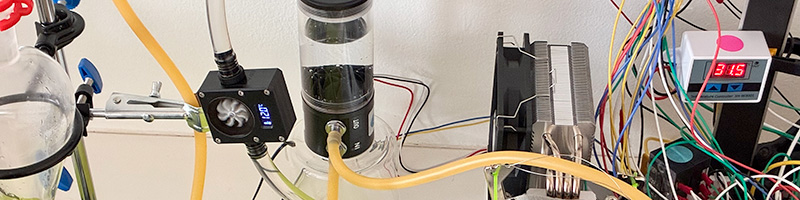
We’re excited to report that we have completed our fifth prototype for the Atmospheric Water Generator (AWG) project, developed in New York City.
This latest iteration is a streamlined, exploratory build that’s designed to investigate new approaches to water condensation beyond the device enclosure. While most of the AWG embodiments that are outlined in our initial patent and early prototypes focused on drawing low-humidity air into an enclosed system for moisture capture, storage, and internal condensation, this prototype shifts part of that process outward.
Specifically, Prototype V allows us to study the desorption and condensation phase well outside of the device, aligning with the concept for geothermal cooling that’s described in our patent. This approach may help expand the system’s flexibility and inform future design directions.
As with earlier prototypes, testing is ongoing, and insights from this version will guide continued development.
WINTER 2026 – Early Biodegradability Tests Show Promising Results for Hygroscopic Biocomposite
We’re pleased to share encouraging early results from initial biodegradability testing of our hygroscopic biocomposite sheets, which are a key material in our Atmospheric Water Generator system.
Designed to capture moisture from low-humidity air, store it, and then release it as high-humidity fog for water production, the biocomposite is composed primarily of an interpenetrating network of biopolymers combined with salt. While we anticipated that the plant-derived material would biodegrade under the right conditions, the timeline remained uncertain.
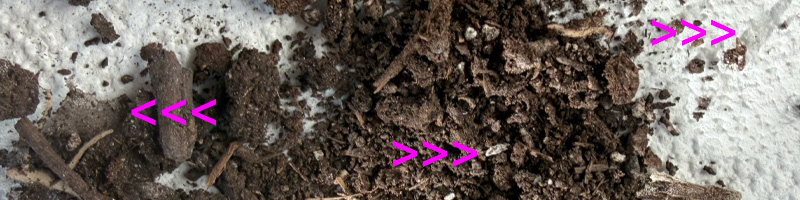
In a simple outdoor garden test, buried samples of our hygroscopic biocomposite sheets decomposed within 90 days, an outcome that exceeded our expectations and clearly suggests that the material is compostable. To ensure accurate recovery of test samples, each sheet included thickened perimeter edges that remained partially visible as fragments, even though the main surface areas had fully disappeared.
These early findings are promising, though additional testing under varied environmental conditions is planned to better understand the material’s biodegradability.
Further updates will be shared as testing continues.
2025
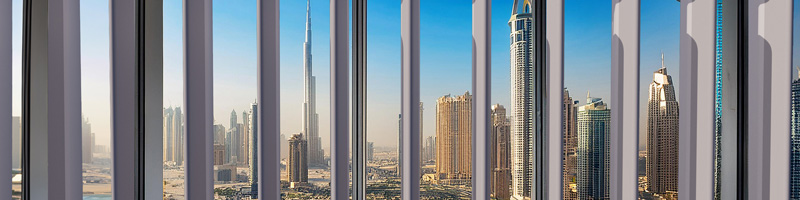
FALL 2025 – This Fall, we are supporting a new design studio course at the Rhode Island School of Design that explores applications for our atmospheric water generators in constructed environments … and we can’t wait to see the results! Students from the departments of Industrial Design and Architecture will work in teams to design atmospheric water generators for tall buildings in arid regions, utilizing responsive biomaterials to transform dry desert air into liquid water. Their approach will span multiple scales, from standalone devices and installations to integrated roof and façade systems for skyscrapers. The is future now!
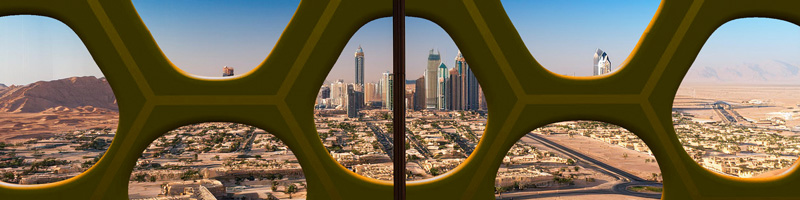
SUMMER 2025 – The USPTO has published a new patent application for our Rapid Hygroscopic Atmospheric Water Generator for a Constructed Environment! This publication (US 20250249394 A1) presents a range of patent-pending embodiments for atmospheric water generators in commercial buildings, residential buildings, factories, greenhouses, infrastructure, etc. We are envision many large scale installations, and will be exploring the promise of this invention in tall buildings this Fall!

SPRING 2025 – We are delighted to announce that we have filed our fourth USPTO application for a brand new invention! And guest what? It’s not about water … it’s about fire! More on that soon. This submission was also substantial, and included 60 drawings of the invention and its various embodiments. As you might have guessed from our animated logo, we’re focused on bio, water, and fire these days, as we continue to develop impactful solutions to the world’s challenges.
WINTER 2025 – We are delighted to announce that the USPTO has issued a patent for our atmospheric water generator [US 12203248 B1]!! We are building a new, larger prototype this Winter, while the weather is cold in NYC, with the assistance of Yeadon Space Agency. Our aim is to have something to test in the field this coming Summer. Maybe we’ll harvest some atmospheric water for a lemonade stand!
2024

FALL 2024 – We are delighted to announce that we have filed our third USPTO application for our atmospheric water generator, which included 93 patent drawings. All of these inventions use a network of plant-derived biopolymers to convert arid air into liquid water. This Fall, we will continue to experiment with the composition of our hygroscopic biomaterials. Increased surface area helps increase water absorption and desorption (among other factors), so microscopy continues to help us envision exactly what’s going on at the nanoscale, thanks to our ongoing partnership with BioCubic.

SUMMER 2024 – We are delighted to announce that we have filed our second USPTO application for our atmospheric water generator, and have received a second bit of funding to help us develop our next prototype! At the core of our technology is a hygroscopic composite made of easily accessible (and abundant) natural materials. Microscopy has helped us envision exactly what’s going on with these biomaterials, thanks to our new partnership with BioCubic.

SPRING 2024 – At SPARK IP, one of the critical patent-pending inventions that we are currently developing aims to help communities address water scarcity. The invention uses a compound of three plant-derived biomaterials to convert arid desert air into liquid water. It began as a Yeadon Space Agency R&D project last year, and was recently moved from the YSA lab bench to SPARK IP for additional prototyping and testing. Our atmospheric water generator is now producing water! We envision numerous applications for this technology … more to come!

WINTER 2024 – We’ve launched! SPARK IP harnesses scientific research to invent new and useful solutions to some of the world’s most pressing challenges. Our areas of focus include: climate adaptation strategies, atmospheric water generation, the sustainable utilization of renewable resources, and disaster mitigation.